
This guide will explain the options, what NSE and BSE options are and what differentiates them from each other.

Indian equities trading activity saw a moderation in FY26, with cash market turnover declining and derivatives growth remaining subdued due to regulatory tightening and weak market performance. Further impacts are expected from new RBI norms and a hike in Securities Transaction Tax (STT).

The market capitalisation of BSE-listed companies eroded by Rs 9,40,581.75 crore to Rs 4,50,61,658.60 crore (USD 4.90 trillion) in a single day.

Using a trading terminal is not suitable for all market participants. Before market participants start using a trading terminal, it is important for them to know who really needs a trading terminal and what they can do with it. Here, we will explore who should actually use a trading terminal.

The BSE Sensex plummeted 1,236 points, wiping out nearly Rs 7 lakh crore in investor wealth, driven by escalating tensions between the US and Iran and subsequent market selloff.

'The next two to three weeks will not be decided in Washington.' 'They will be decided in Tehran, in whatever calculation Iran makes about the costs of continued resistance against the costs of appearing to have yielded.'

Shares of brokerage-related companies nosedived 18 per cent on Sunday after Finance Minister Nirmala Sitharaman proposed raising securities transaction tax on commodity futures to 0.05 per cent from 0.02 per cent in the Union Budget 2026-27.

Finance Minister Nirmala Sitharaman on Sunday announced an increase in the Securities Transaction Tax (STT) on Futures and Options trade with a view to discouraging small investors from speculative trading in derivatives, which led to a sharp decline in the stock market.

The Union Budget for 2026-27, presented by Finance Minister (FM) Nirmala Sitharaman on Sunday, which was a first, had an excellent domestic macro backdrop. According to the first advance estimates, gross domestic product (GDP) in constant prices is projected to grow 7.4 per cent in the current financial year, against 6.5 per cent in 2024-25.

Benchmark stock indices Sensex and Nifty dived sharply by nearly 2 per cent on Sunday after Finance Minister Nirmala Sitharaman proposed a hike in the Securities Transaction Tax (STT) on derivatives. Reversing the early gains, the 30-share BSE Sensex plunged sharply by 2,370.36 points or 2.88 per cent to slide below the 80,000-mark at 79,899.42 in afternoon trade as the finance minister announced a hike in STT on futures contracts to 0.05 per cent from the current 0.02 per cent.

The average daily turnover (ADTV) in the derivatives market rose to a 12-month high in October, touching 506 trillion - up nearly 46 per cent since June - as volatility picked up and concerns over further regulatory tightening eased. Derivatives activity had slumped earlier this year after the Securities and Exchange Board of India (Sebi) capped weekly expiries to two days and discontinued weekly contracts on non-benchmark indices.

The Indian metal market is a promising sector to invest in as it provides a good balance between the prospects of growth and stability in dynamic economic conditions and a changing geopolitical environment. Metals such as gold, silver, copper, etc, have gained renewed significance in 2025, amidst growing inflation and India's push towards infrastructural growth and green energy initiatives.
The Indian metal market is a promising sector to invest in as it provides a good balance between the prospects of growth and stability in dynamic economic conditions and a changing geopolitical environment. Metals such as gold, silver, copper, etc, have gained renewed significance in 2025, amidst growing inflation and India's push towards infrastructural growth and green energy initiatives.

Co-location attracts institutional investors, which drives volumes for long-dated options, with higher realisations at lower costs.

In a move that could have implications for market share dynamics, the Securities and Exchange Board of India (Sebi) has permitted the National Stock Exchange (NSE) and the BSE to alter the days for settlement of equity derivatives contracts.

Shares of BSE on Wednesday tumbled more than 9 per cent after its rival NSE said that all Nifty index weekly derivatives contracts will expire on Monday instead of Thursday with effect from April 4. The stock of BSE tanked 9.39 per cent to Rs 4,035.10 apiece on the National Stock Exchange (NSE).

'Earnings growth will be the main driver of India's market in 2026, with profits expected to rise 9% to 10% in H2 FY26 and accelerate to 12% to 15% in FY27.'

A record amount of pension money may be finding its way into the stock market, if buying figures in the National Stock Exchange (NSE) data are any indication. Category inflows touched Rs 37,409 crore for the three months ending September 2025, shows an analysis of NSE data.

This marks a rebound after more than two years of underperformance during a strong rally in smallcap stocks.

'Market momentum and investor interest are at unprecedented levels, making this the opportune moment.'

BSE 200 companies together paid 5,819.75 crore as remuneration to their CEOs and directors in FY25, up from 5,352.8 crore a year earlier.

The surge in the market price is also attributed to demand by retail and high-networth individual investors ahead of the IPO.

BSE's fresh shot at cracking the derivatives market is off to a promising start. However, Asia's oldest bourse is facing resistance from brokerages with nearly 10 large brokers yet to offer the relaunched Sensex and Bankex derivatives on their platforms. Many brokers maintain that they are working on the back end to enable BSE derivatives on their apps and websites. Some said while volumes are picking up, they are still miniscule compared to bigger rival NSE, which is the most-preferred venue for derivatives trading. Only a few brokers responded to formal queries sent by Business Standard on the issue of allowing BSE derivatives on their platform.
Leading stock exchange the BSE on Thursday announced the discontinuation of weekly index derivatives contracts on Sensex 50 and Bankex, following a new directive from markets regulator Sebi. In its circular, BSE said weekly index derivatives contracts on the Sensex 50 will be discontinued from November 14 after the expiry of existing contracts. No new weekly contracts will be generated.

'All commercial and banking transactions happen in South Mumbai.'
Stocks of brokerages and market infrastructure institutions (MIIs) witnessed selling pressure after the Securities and Exchange Board of India's (Sebi's) crackdown on proprietary trading firm Jane Street. The weakness was attributed to concerns that debarment of the US firm - a prominent player in the futures and options (F&O) segment - will lead to a further decline in volumes, which are already down over 30 per cent from the peak.
BSE (formerly Bombay Stock Exchange) has seen its market share go past the critical 20 per cent mark in the derivatives segment, intensifying its battle with bigger rival - the National Stock Exchange (NSE) - which, less than a year ago, had a monopoly in this space. In April, the average daily trading volume (ADTV) for BSE stood at Rs 89 trillion, accounting for 20.6 per cent of the overall ADTV of Rs 432 trillion (based on notional volumes for options).
The BSE faces a larger outgo after regulatory clarity on the fee to be paid to the Securities and Exchange Board of India (Sebi) as a turnover charge on options volume. The market regulator on Friday directed the exchange to pay a regulatory fee on the 'notional value' of annual turnover.

Ask rediffGURU and PF and MF expert Janak Patel your mutual fund and personal finance-related questions.

Fintech firm One97 Communications' managing director and chief executive officer Vijay Shekhar Sharma has voluntarily surrendered 2.1 crore shares worth about Rs 1,800 crore, as per a regulatory filing and share closing price of the company.
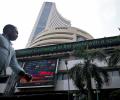
BSE on Monday relaunched Sensex and Bankex derivative contracts in its bid to boost derivative trading at the country's premier bourse. The relaunch of derivative contracts comes with a reduced lot size of futures and options and a new expiry cycle of Friday from Thursday earlier, BSE said. Derivatives are considered to be high-risk-reward financial instruments aimed at hedging risk in the equity market.
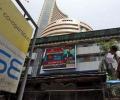
Rising outgo towards clearing and settlement fees has led to an altercation between the BSE and the National Stock Exchange of India (NSE), with the latter striking down the former's request to lower the charges. NSE said it has no plans to restructure the same and that it will continue with the pricing defined under the interoperability framework. The interoperability framework, introduced in 2019, allows trades executed on any of the exchanges to be settled or cleared at either of the two clearing corporations -- NSE Clearing (NCL) or Indian Clearing Corporation (ICCL), fully-owned by the NSE and the BSE, respectively.

'It is like a chicken-and-egg situation.' 'All these product tweaks are innovative, but traders won't move unless there is liquidity.' 'And liquidity cannot be generated until traders move.'

India's second largest IT company Infosys' board has approved the grant of stock incentives or Employee Stock Option Plans (ESOPs) worth over Rs 51 crore to CEO and MD Salil Parekh. These stock incentives are under various heads including ESG and equity, and add up to over Rs 51 crore.

Weak market sentiment has driven a steady decline in cash market volumes and margin trading books over the past nine months. Cash market volumes have plummeted by 45 per cent from their peak in June 2024, while the margin book - used by traders to leverage stock purchases - has shrunk by 16 per cent since its high in September 2024.

The share of Ahmedabad in the total value of trades on both the BSE and NSE is set to touch double digits for the third year in a row.
The BSE is planning to reintroduce its Sensex-30 derivatives and is in the process of collecting feedback from members, the MD and CEO of the premier bourse, Sundararaman Ramamurthy, said on Friday. The Sensex-30 derivatives products (options and futures), which were launched in 2000, had failed to generate much interest among investors compared to the rival exchange's Nifty-50 derivatives. "We are trying to reintroduce Sensex-30 derivatives, and have started the consultation process by taking the feedback of market participants," Ramamurthy said at an Assocham-organised event in Kolkata.

Investing is not just about setting aside money -- it's about making it work for you, says Ramalingam Kalirajan.
The BSE has decided to move the expiry day of Bankex derivatives contracts from Friday to Monday, effective October 16, the bourse said on Wednesday. "New contracts of S&P BSE Bankex with Monday expiry will be generated on October 13, 2023, and will be available for trading with effect from October 16, 2023," the BSE said, citing the decision was based on the market feedback. The expiry of Sensex derivatives contracts will continue to be on Friday.

The National Stock Exchange (NSE) will shift the expiry of Bank Nifty derivatives contracts from Thursday to Friday, after smaller rival BSE did so earlier. The change, effective July 7, will apply to both weekly and monthly futures and options (F&O) contracts of the widely traded banking sector index. The first Friday expiry will be on July 14, 2023. NSE dominates the derivatives segment.
 © 2026 Rediff.com - Advertise with us - Disclaimer - Privacy Policy - Sitemap - Feedback - About us - Terms of use - Grievances